travel south america peru lima pueblo libre district museo larco gold & jewelry exhibit

Gold & Jewelry exhibits are found in Rooms 11, 12, and 13...
"The clothing and adornments used by the rulers of ancient Peru were symbols which denoted who they were during life and who they would become after death." - Museo Larco
LINK TO WIKIPEDIA'S WEB PAGE ON PERU
LINK TO WIKIPEDIA'S WEB PAGE ON LIMA
LINK TO WIKIPEDIA'S WEB PAGE ON MUSEO LARCO
LINK TO WEB PAGE FOR MUSEO LARCO
TRAVEL: March, 2024...

This location has earned an over-all four-and-a-half star (very good+) rating from
Travel Fanatics Unlimited
****1/2
unless noted otherwise all images copyright d. holmes chamberlin jr architect llc
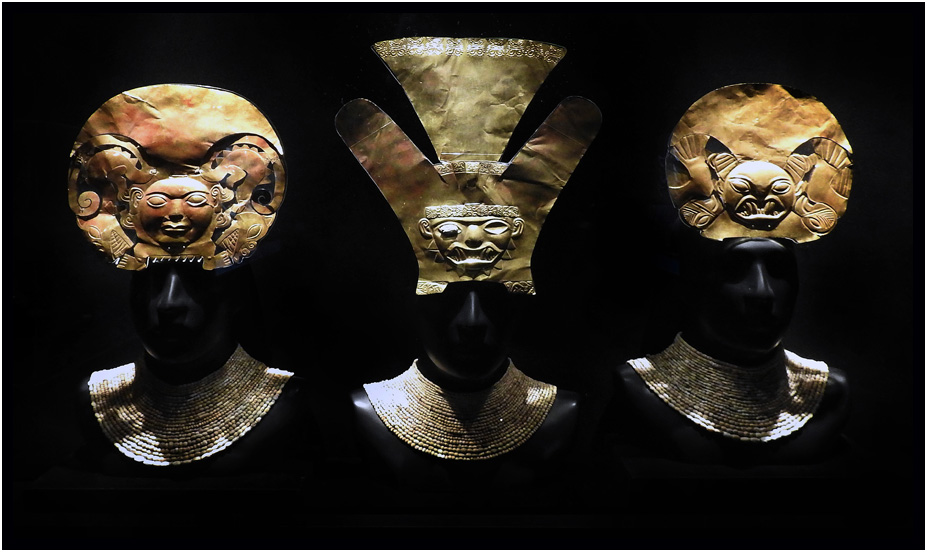
Gold headdresses, Moche Florescent Epoch (1 AD - 800 AD), Gold & Jewelry exhibit, Museo Larco, Lima, Peru, 2024.
"Leaders were crowned with decoration symbolizing their ability to act as intermediaries between different worlds,
as in the case of this adornment, which depicts a powerful mythological being with feline, fox, bird, and serpent features." - Museo Larco
-001-2024.jpg)
Chimu silver crowns and adornments, Imperial Epoch (1300 AD - 1532 AD), Gold & Jewelry exhibit, Museo Larco, Lima, Peru, 2024.
"In societies like Chimu, silver was used in the attire of the nobility.
Crowns, diadems, breastplates, ear ornaments, nose ornaments, necklaces and bracelets formed the offerings placed in the tombs of the elite.
The iconography on these objects was associated with the ancestor or deceased ruler, who would be surrounded by other figures with the forms
or features of felines and birds." - Museo Larco
-002-2024.jpg)
Vicus funerary attire, crowns and headdresses, Formative Epoch (1250 BC - 1 AD), Gold & Jewelry exhibit, Museo Larco, Lima, Peru, 2024.
"The political and religious leaders of the societies of ancient Peru consolidated their power duroing the Formative Epoch.
The members of the elite dressed themselves with crowns, breastplates, ear ornaments and nose ornaments made from gold and copper and,
when they died, these objects which were part of their identity, went with them into the next world." - Museo Larco
-001-2024.jpg)
More Vicus funerary attire, crowns and headdresses, Formative Epoch (1250 BC - 1 AD), Gold & Jewelry exhibit, Museo Larco, Lima, Peru, 2024.
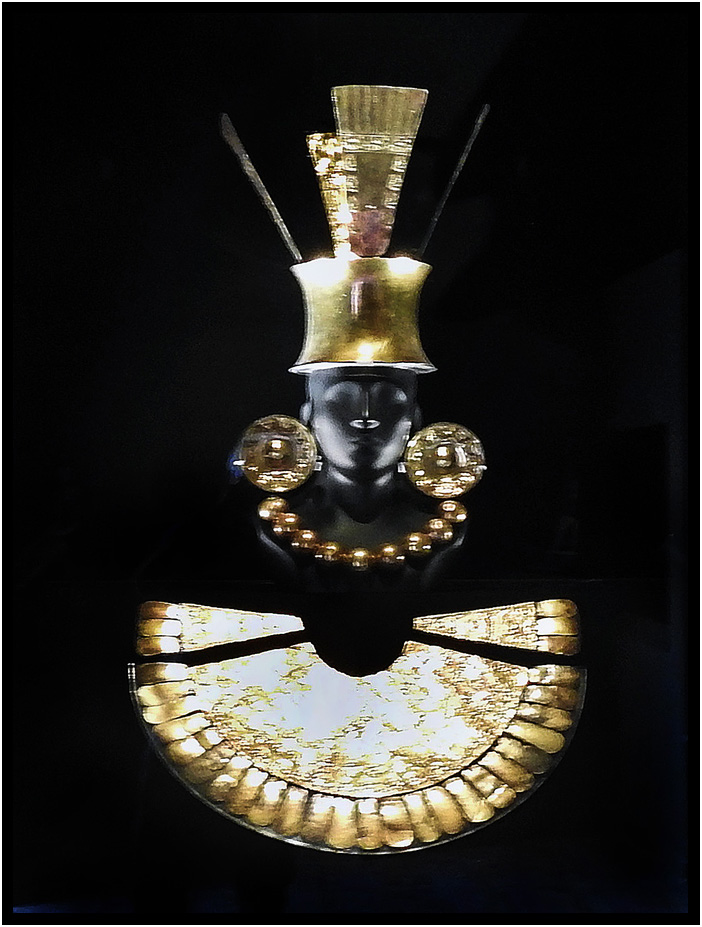
Chimu funerary attire, Gold & Jewelry exhibit, Museo Larco, Lima, Peru, 2024.
"This gold attire once belonged to a major leader of the mud brick city known as Chan Chan, the capital of the Chimu empire.
The feathers on the crown, breastplate and epaulettes express the relationship between birds and the sun, in the celestial world." - Museo Larco
-001-2024.jpg)
Breastplates of shell, stone, and metal, (1250 BC - 800 AD), Gold & Jewelry exhibit, Museo Larco, Lima, Peru, 2024.
"The personal adornments of the elite were manufactured from materials which were not readily accessible to the general populace.
These pieces tell us that the elite enjoyed exclusive access to prestige items.
Such items included seashells from tropical seas, such as Strombus and Spondylus, and gemstones such as turquoise and chrysocolla." - Museo Larco
-001-2024.jpg)
Mochica gold ear ornaments, Florescent Epoch (1 AD - 800 AD), Gold & Jewelry exhibit, Museo Larco, Lima, Peru, 2024.
"Ear ornaments were one of the most significant adornments used to distinguish those individuals in power in Andean societies.
When the Spanish arrived they called the Incas nobles "orejones" (literally, "big ears"), in reference to the size of their ears, which were enlarged by the adornments the wore.
Some of these ear ornaments were so heavy and large that theyu were held in place by bands wraped around the wearer's head." - Museo Larco
-001-2024.jpg)
Gold necklesses, bracelets, belts, and rings (1 AD - 1532 AD), Gold & Jewelry exhibit, Museo Larco, Lima, Peru, 2024.
"For ancient Peruvians, in symbolic terms gold and silver were complemenmtary. Through their color and brightness both metals were associated with the concept of duality.
Gold represented the sun, the day and all that was masculine, while silver represented the moon, the nigtht and all that was considered feminine." - Museo Larco
-001-2024.jpg)
Shell, stone, bone and wood jewelry (1250 BC - 1532 AD), Gold & Jewelry exhibit, Museo Larco, Lima, Peru, 2024.
copyright d. holmes chamberlin jr architect llc
page last revised july 2024