travel south america peru lima pueblo libre district museo larco death in ancient peru exhibit

The Death in Ancient Peru exhibit is found in room 10 of the Museo Larco.
"When the leaders of pre-Columbian societies died they aspired to a semi-divine status in order to draw closer to the gods.
Funerary rituals were essential to the successful outcome of this transformation." - Museo Larco
LINK TO WIKIPEDIA'S WEB PAGE ON PERU
LINK TO WIKIPEDIA'S WEB PAGE ON LIMA
LINK TO WIKIPEDIA'S WEB PAGE ON MUSEO LARCO
LINK TO WEB PAGE FOR MUSEO LARCO
TRAVEL: March, 2024...

This location has earned an over-all four-and-a-half star (very good+) rating from
Travel Fanatics Unlimited
****1/2
unless noted otherwise all images copyright d. holmes chamberlin jr architect llc
-001-2024.jpg)
-002-2024.jpg)
Huari Funerary Bundle, Fusion Epoch (800 AD - 1300 AD), Death in Ancient Peru exhibit, Museo Larco, Lima, Peru, 2024.
"This funerary bulndle clothed in finery and a funerary mask contains the body of a child, wrapped in cloth.
As occurred in ancient Egypt, the dead were carefull prepared for their jouirney into the underworld." - Museo Larco
-001-2024.jpg)
Miniature funerary offerings including a Chimu loincloth decorated with silver fish (1 AD - 1532 AD), Death in Ancient Peru exhibit, Museo Larco, Lima, Peru, 2024.
"In some funerary contexts from the north coast groups of miniature offerings have been found.
Usually, these offerings represent a specific theme, such as important mythological narratives related to burial, the obtaining of
Spondylus shells, or the ceremonial attire." - Museo Larco
-001-2024.jpg)
Chimu Miniature Funerary Offerings, Imperial Epoch (1300 AD - 1532 AD), Death in Ancient Peru exhibit, Museo Larco, Lima, Peru, 2024.
"The probable origin of this offering was the tomb of a young woman from the Chimui elite who was buried in the mud city of Chan Chan.
The group of miniatures was found inside a finely decorated silver box." - Museo Larco
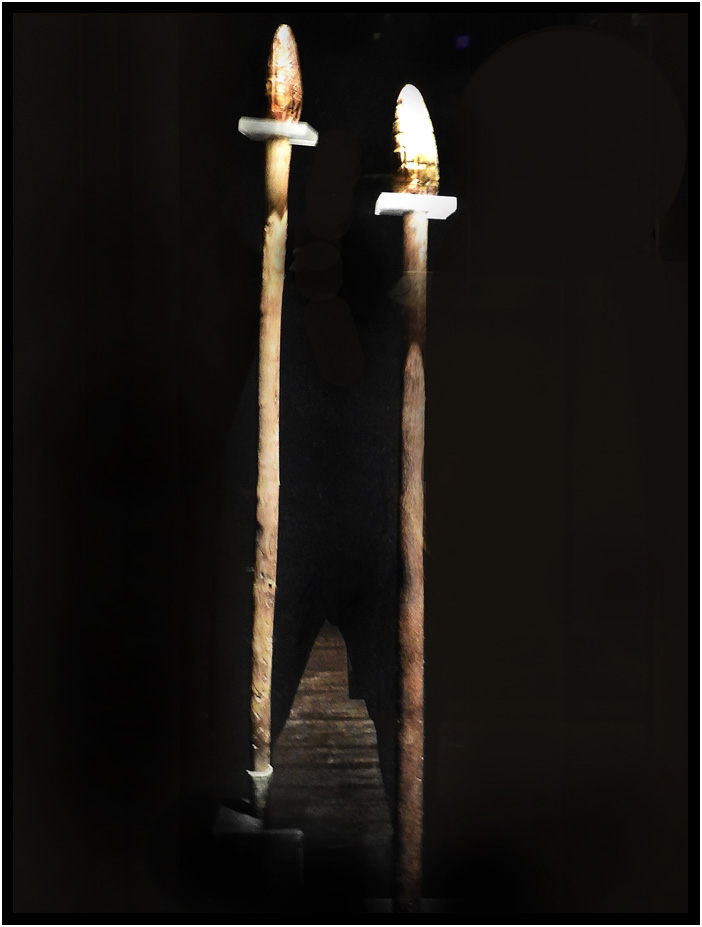
Mochica Ceremonial Scepters with golden heads shaped like ears of corn, Death in Ancient Peru exhibit, Museo Larco, Lima, Peru, 2024.
"In ancient Peru gold was symbolically associated with the brightness and warmth of the sun, which was responsible for the growth of plants.
Corn was the cereal crop used to prepare chicha, the ritual and celebratory beverage of the Andes." - Museo Larco
-001-2024.jpg)
Chancay Head of Funerary Bundle, Imperial epoch (1300 AD - 1532 AD), Death in Ancient Peru exhibit, Museo Larco, Lima, Peru, 2024.
"This head became part of the Larco Museum collection around the middle of the 20th century.
Its characteristics indicate that it once formed part of an enormous Chancay funerary bundle, similar to others which have been discovered during later excavations.
Some bundles include components known as "false heads", which were made from reeds, fiber and cloth and then painted and adorned with metal decoratons.
The aim of this practice was to create the face of the ancestor of the social group to which the deceased belonged.
The preparation of these mortuary elements propitiated the process of transformation of the deceased into a communal ancestor." - Museo Larco
-001-2024.jpg)
Deformed and Transpanated Skulls (1250 BC - 1532 AD), Death in Ancient Peru exhibit, Museo Larco, Lima, Peru, 2024.
"In ancient Peru several societies practiced skull trepanation.
This was a surgical procedure employed to eliminate hematomas or remove pieces of bone from skulls which were probably fractured durintg ritual combat or fighting between warriors.
These operations were also performed to relieve pain or other afflictions affecting the head.
Transpanned skulls display evidence of bone regeneration after operating, which indicates that some individuals survived these procedures.
Different instruments were used for trepanation, including obsidian (natural glass) and metal knives (copper or copper alloy).
Skull deformation ws also practiced, and the aim of this procedure was to give a particular shape to the heads of individuals who belonged to a given social group..." - Museo Larco
-001-2024.jpg)
Funerary Masks (1 AD - 1300 AD), Death in Ancient Peru exhibit, Museo Larco, Lima, Peru, 2024.
"Funerary masks formed an important element in the burial of the leaders of ancient Peruvian societies.
Masks were important symbols of the identity of the deceased, who would be transformed into the image depicted.
Masks were decorated with inlaid seashells or painted with the red pigment known as cinnabar (mercury sulfate).
Copper Mochica funerary mask representing the god Ai Apaec; gilded copper Huari funerary masks." - Museo Larco
copyright d. holmes chamberlin jr architect llc
page last revised july 2024