travel south america peru lima pueblo libre district museo larco ancient cultures of peru exhibit

The Ancient Cultures of Peru exhibit is one of the first sections of the main Larco Museum, Lima, Peru.
As noted before, I went through the museum quite fast, stopping only to photograph exhibits, and then was able to study them in more detail later.
Like the whole museum, this section was beautifully presented with educational tags in many languages.
LINK TO WIKIPEDIA'S WEB PAGE ON PERU
LINK TO WIKIPEDIA'S WEB PAGE ON LIMA
LINK TO WIKIPEDIA'S WEB PAGE ON MUSEO LARCO
LINK TO WEB PAGE FOR MUSEO LARCO
LINK TO WEB PAGE FOR MUSEO LARCO - CULTURES OF ANCIENT PERU
TRAVEL: March, 2024...

This location has earned an over-all four-and-a-half star (very good+) rating from
Travel Fanatics Unlimited
****1/2
unless noted otherwise all images copyright d. holmes chamberlin jr architect llc
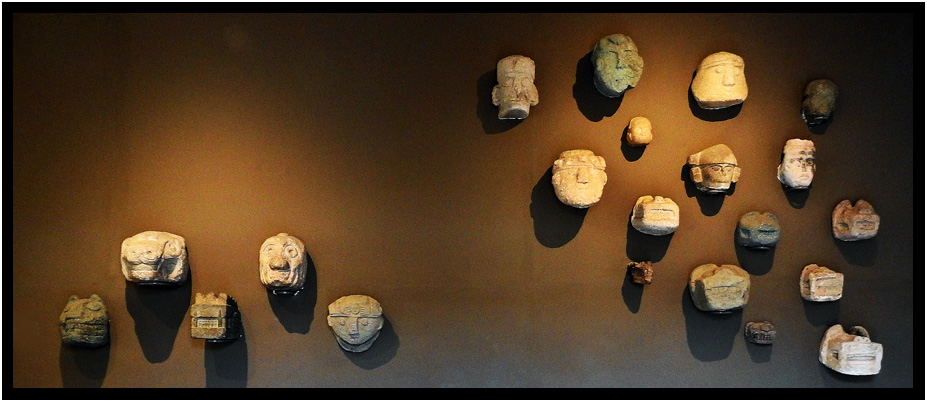
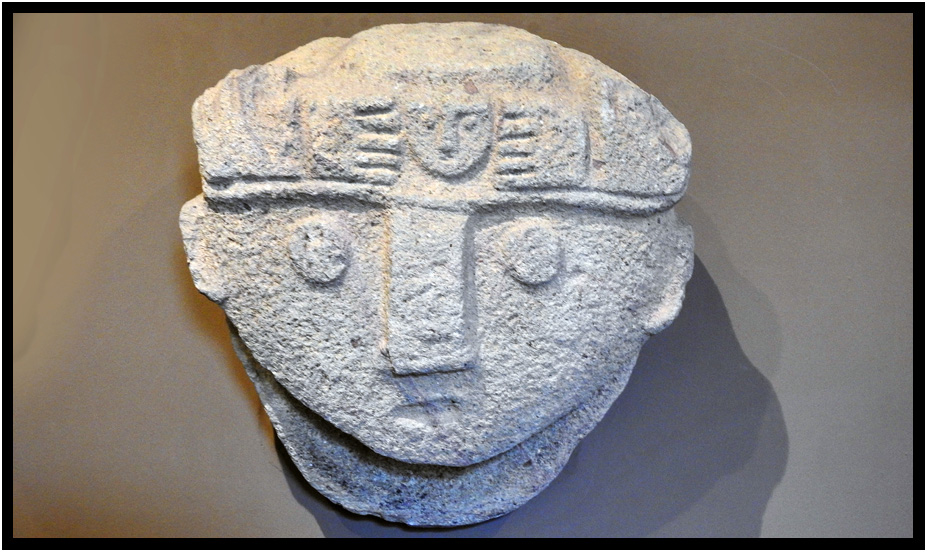
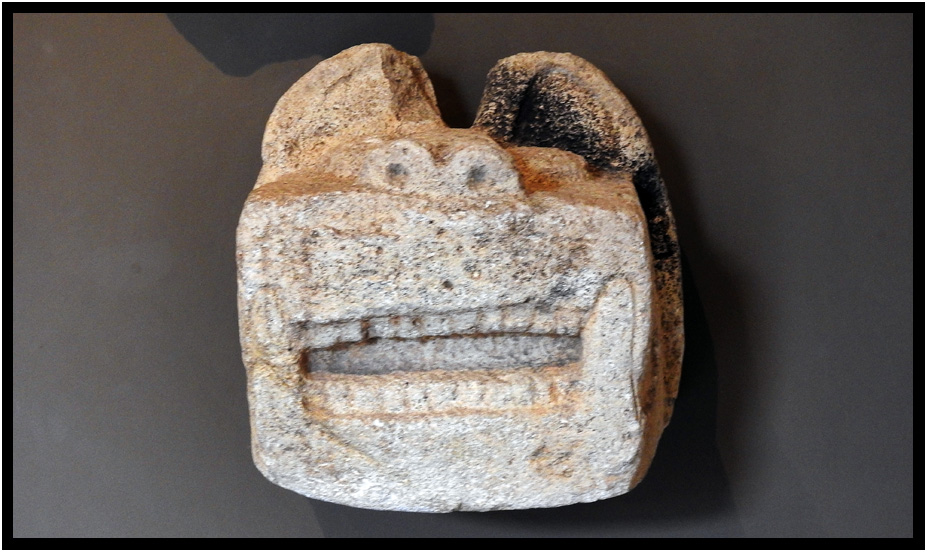
Stone heads which originally protruded from the exterior wall of a temple at the Chavin religious site of Chavin de Huantar, Ancient Cultures exhibit, Museo Larco, Lima, Peru, 2024.
"Over 100 such heads have been found, each is unique and represents the transformation of a shaman into a supernatural fanged creature."
.jpg)
Stone spearheads, Pre-Ceramic Epoch (8000 BC - 2000 BC), from Peru's northern coast Paijan archaeological site, Ancient Cultures exhibit, Museo Larco, Lima, Peru, 2024.
"Ten thousand years ago the hunter-gatherers who had begun to inhabit the coast learned to exploit the resources of Peru's seas. They fished and hunted using stone spearheads." - Museo Larco
-001-2024.jpg)
Pacopampa Feline, an ancient sculpture representing a sacred feline, a jaguar, Ancient Cultures exhibit, Museo Larco, Lima, Peru, 2024.
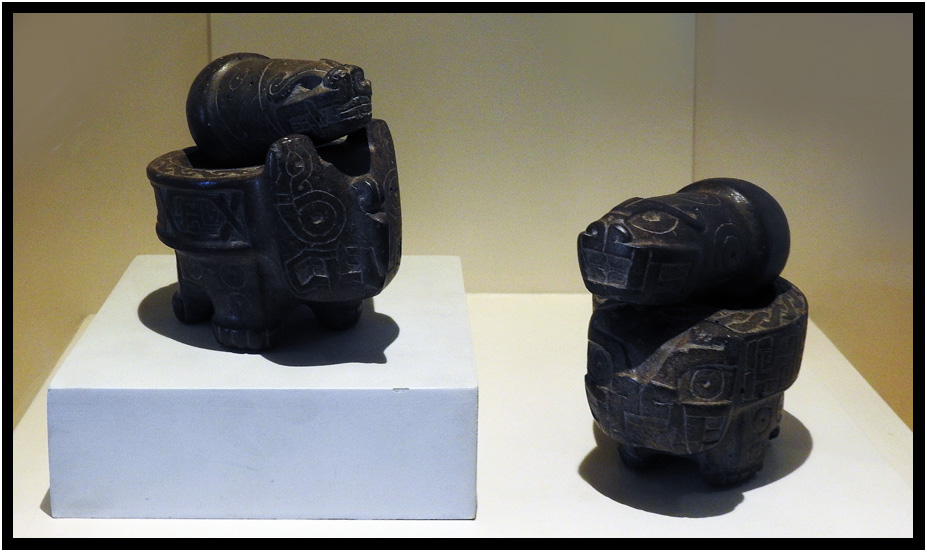
Stone mortar and pestles representing the fusion of 3 sacred animals... a bird, a feline, and a serpent, Ancient Cultures exhibit, Museo Larco, Lima, Peru, 2024.
-001-2024.jpg)
Pacopampa Stela, a stone monument from Pacopampa in Peru's northern highlands, Ancient Cultures exhibit, Museo Larco, Lima, Peru, 2024.
"...a figure carved in low relief with incised details. The head has rectangular eyes, and fluids appear to emanate downward from its mouth;
the diamond shaped form on the chest may represent a Strombus shell. Upraised arms and diagonal extensions from the waist give the figure a spiderlike quality.
Jaws in the lower abdomen may represent female genitalia." - THE MET
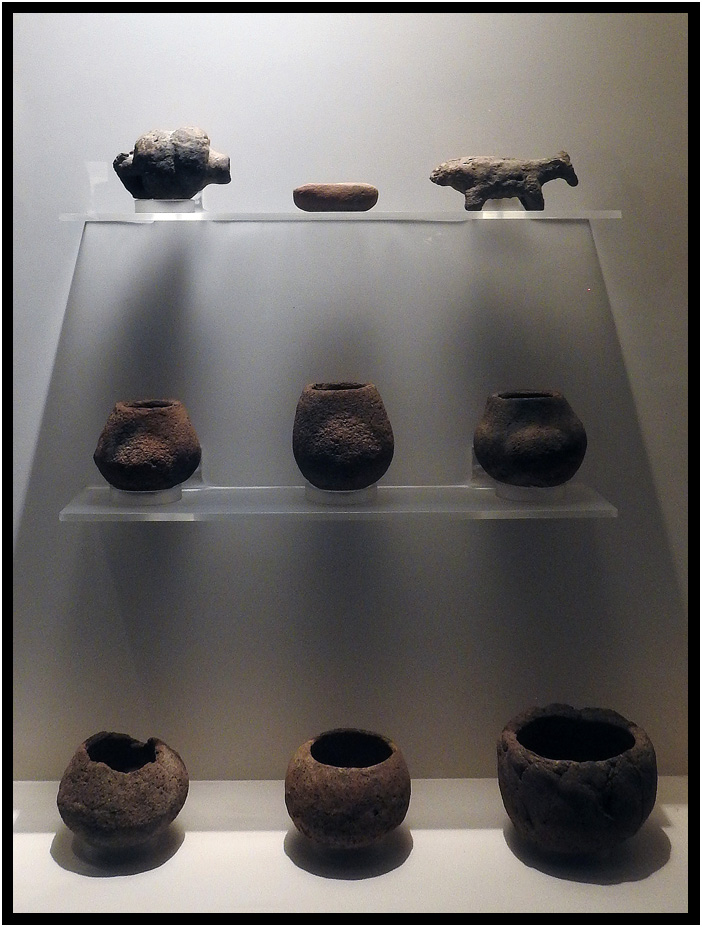
Clay vessels, Early Ceramic Epoch (2000 BC - 1250 BC), from Peru's northern coast Queneto archaeological site, Ancient Cultures exhibit, Museo Larco, Lima, Peru, 2024.
"The fishermen-gathers of the valleys began to practice agriculture. Together with their economic and social advances, their inventiveness also developed.
These societies began to produce open-fired pottery. The first designs of vessels resembled the fruits and animals of the surrounding environment." - Museo Larco
-2024.jpg)
Union of the Feline, Bird and Serpent in a sculptural Viru Pitcher, Formative Epoch (1250 BC - 1 AD), northern coast, Ancient Cultures exhibit, Museo Larco, Lima, Peru, 2024.
"Pre-Columbian art features a being which is the result of a combination of the physical and supernatural characteristics of the feline, the serpent and the bird.
This mythical being combines the strengths of the three worlds and is represented by multiple combinations, for example the head of a bird, paws of a feline and body of a serpent." - Museo Larco
-2024.jpg)
Union of the Feline, Bird and Serpent in a sculptural Viru Pitcher, Formative Epoch (1500 BCE - 500 BCE), northern Peru, Ancient Cultures exhibit, Museo Larco, Lima, Peru, 2024.
"The Cupisnique culture flourished between 1500 BCE to 500 BCE in northern Peru. The Moche culture succeeded Cupisnique and borrowed many ideas from them."
-001-2024.jpg)
Vicus double chambered vessel, Formative Epoch (1250 BC - 1 AD), north coast, Ancient Cultures exhibit, Museo Larco, Lima, Peru, 2024.
"The Vicus culture developed in the department of piura in the far north of Peru. This region functioned as a cultural frontier between
the areas now occupied by Ecuador and Peru, and the artistic characteristics of both regions can be seen in Vicuis art.
This double-chambered sculptural vessel decorated with the negative painting technique represents a nude male with a painted body.
He is wearing a metal crown with flaps like the one that can be seen in the Gold Room of the Larco Museum.
He is also wearing very large ear plugs - an indication of high rank - and a necklace made from beads shaped like human faces." - Museo Larco
-2024.jpg)
Moche Owl God, Apogee Epoch (1 AD - 500 AD), Ancient Cultures exhibit, Museo Larco, Lima, Peru, 2024.
"An anthropomorphic owl dressed as a warrior and standing under an arch formed by a serpent with two feline heads.
This is one of the principal gods of Moche culture and is associated with the night, the occult, and death." - Museo Larco
a-.jpg)
Lambayeque pottery, Fusion Epoch (800 AD - 1300 AD), Ancient Cultures exhibit, Museo Larco, Lima, Peru, 2024.
"In Lambaeque pottery there is a continuation of the sculptural tradition of the north.
The double spout and bridge handle forms of the vessels come from the southern pottery tradition.
These ceramics feature a figure with wing-shaped eyes, pointed ears with large ear plugs and half-moon headress.
This individual would have been conceived as a representation of the mythical heroic founder of the ruling dynasty, known as Naylamp, who was deified." - Museo Larco
.jpg)
Chimu Idol, Imperial Epoch (1300 AD - 1532 AD), Ancient Cultures exhibit, Museo Larco, Lima, Peru, 2024.
"A wooden sculpture representing a high dignitary from the Chimu culture wearing a funerary mask and holding a ceremonial vessel.
Sculptures like this decorated the main patios of Chimu citadels. In this way a kind of stage design was created within which
these figures continued to preside over society's principal ceremonies." - Museo Larco
-2024.jpg)
Chincha Sculpture, Imperial Epoch (1300 AD - 1532 AD), Ancient Cultures exhibit, Museo Larco, Lima, Peru, 2024.
copyright d. holmes chamberlin jr architect llc
page last revised july 2024